
Concrete Foundations in Boston, MA
Building Strong from the Ground Up with Boston Concrete Works
The crew at Boston Concrete Works has an understanding of how important the foundation of any type of building is, whether that is a home addition or a new office. When a customer hires us, they will be working with people who have experience with constructing concrete bases. Regardless of size, the projects begin on stable ground. They create strong, durable foundations to match the specific dirt conditions and climate of the area. Each location is reviewed individually to understand the potential frost and soil issues in the area, as well as how those may affect the preparation and construction of each project. To ensure that every base poured lasts for years to come, we ensure the ground is prepared properly and uses the highest quality mix.
Our mission is to complete all aspects of the job (from initial excavation to final pouring) with attention to detail and the intent of completing the task correctly the first time. Whether a customer needs a small base for a backyard shop or a large commercial base, we will bring the same amount of dedication and knowledge of their local market to the job. We feel that a successful project begins with a strong working relationship between our company and the customer. Therefore, we will communicate regularly with the customer as we build a foundation that meets the customer’s vision and protects their investment. Ultimately, we strive to offer customers a reliable, stress-free beginning to their construction projects and allow them to construct safely and level for years to come.
Get A Free Quote
What is a Concrete Foundation?
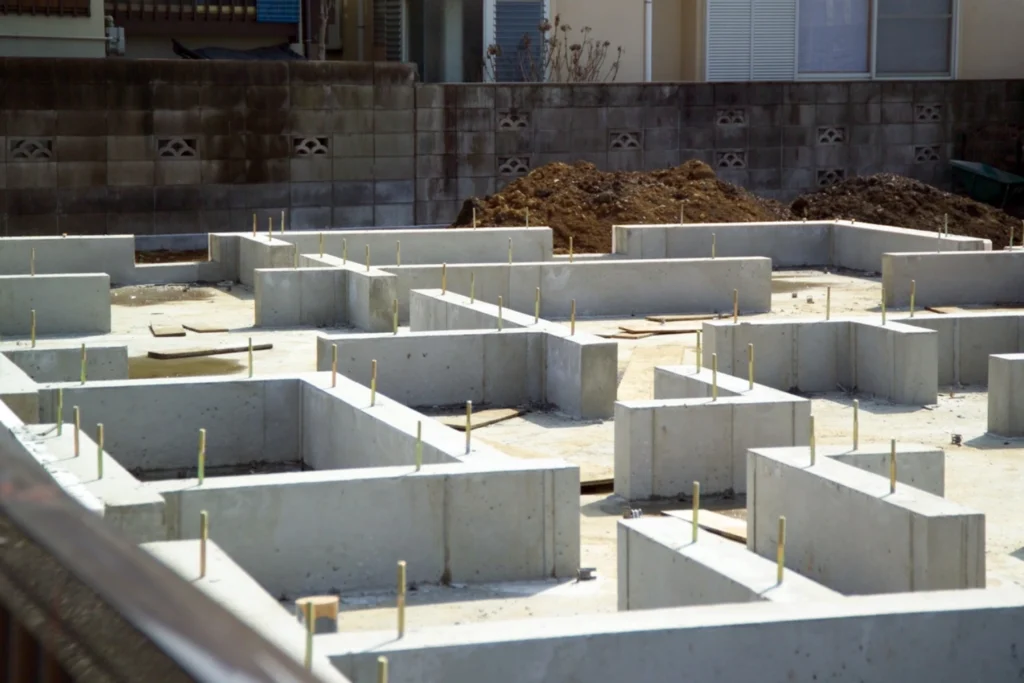
Concrete foundations serve as an extremely heavy-duty structural base of a building that rests right on the ground. The primary function of a concrete foundation is to create a stable, even base upon which to build while distributing the weight of the building above it evenly into the soil beneath it to prevent settling (sinking) and/or movement (shifting). A concrete foundation in our region serves another vital purpose; it creates a solid wall around the exterior of the foundation and prevents moisture from rising from the ground into the basement space while resisting the natural expansion and contraction of the soils during Boston’s freezing winter months.
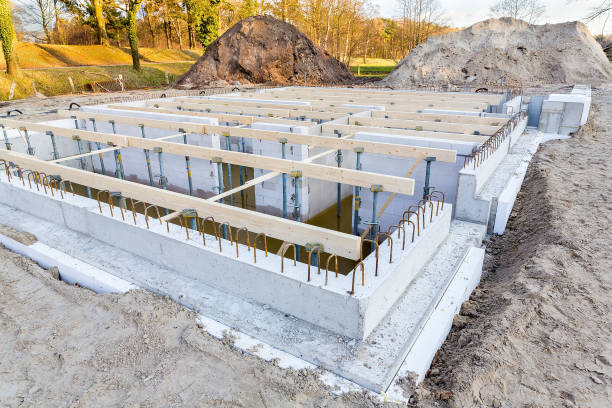
Foundations come in many forms based on the type of project. Foundations can be either shallow (slab-on-grade), or deeper (deep T-shaped) and pour at different times. All styles of foundations require reinforcement with steel rebar in order to have sufficient strength to withstand the forces exerted by the earth and the weight of the house. A poorly engineered concrete foundation will eventually result in cracking, tilting, or structural damage to the building as the ground continues to move over time.
Why Choose Concrete Foundations?
- Strong Structural Support: Strong structural support is provided. The foundational system provides a significant amount of strength because it supports all of the components of the building and the stability of the building under load. When the weight of the walls and roof is distributed evenly throughout the earth, the uneven settling that leads to structural failure is prevented.
- Long-Term Durability: Long-term durability is achieved. They will be able to withstand the freeze-thaw cycles of Boston, maintaining their integrity through all seasons. High-strength concrete mixes are used to counteract the internal pressure caused by moisture expansion during the winter months.
- Soil Movement Resistance: The foundation will resist soil movement. Designed properly, the foundation will remain stable even if there is some shifting in the soil. Using strategically placed reinforcement and deep footings, we can make sure that your building will remain level even though the ground naturally expands and contracts.
- Moisture Protection: Proper moisture management will help prevent problems such as basement flooding. We will include vapor barriers and drainage systems to keep your lower levels dry and free from mold or dampness.
- Energy Efficiency: With the right insulation, the foundation can decrease heating and cooling costs over time. Concrete has a high thermal mass that can absorb and release heat slowly to regulate the temperature of your home or business.
- Generational Longevity: If built correctly, well-designed foundations can last for many generations with very little maintenance as long as they are kept in good condition. In fact, unlike most building materials, concrete becomes stronger than it was at the beginning as it ages, providing a permanent foundation for your building.
- Versatility: Their versatility makes them suitable for a wide variety of buildings and conditions of soil conditions. Whether you are building on the rocky terrain of the North Shore or the clay-heavy soils of Greater Boston, we can modify the foundation design to meet the unique conditions of your area.
Our Concrete Foundation Services
Residential Foundations
From small Cape Cod homes to larger Colonial-style homes, we provide strong foundation systems to support the structural integrity of homes of all sizes. Working hand-in-hand with the residential builder, we ensure each and every measurement is accurate in order to establish a stable and level surface for the family’s residence.
Commercial Foundations
Whether you are working on a high-rise office building or a large retail store, we have the experience to complete large-scale commercial projects. Understanding the demand of commercial construction (increased load-bearing requirements, code compliance, etc.), we ensure that your business will be built on a solid foundation.
Addition Foundations
When adding a new living space to an existing home, we work to seamlessly connect the two with a matching foundation system. With years of experience working with addition foundations, we focus on connecting new foundation systems to existing foundation systems to prevent the addition from pulling away or settling at a different rate than the main home.
Garage Foundations
For garage use, we install strong reinforced foundation systems designed to accommodate the weight of cars, trucks, and equipment. The foundation slabs installed by us are designed with additional thickness and heavy-duty reinforcement to allow them to withstand the weight and movement of vehicles without cracking or shifting.
Basement Foundations
Utilizing modern vapor barrier and exterior drainage techniques, we develop dry basement foundation systems that can be finished or used for storage. This creates additional usable space within a home, making it easier to live in.
Foundation Repairs
If your existing foundation system is damaged and exhibiting signs of stress (cracks, uneven settling, etc.), we can assess the damage and perform repairs using professional reinforcement or leveling techniques to protect the value of your property.
Types of Foundations we Offer
Slab-on-Grade (Slab)
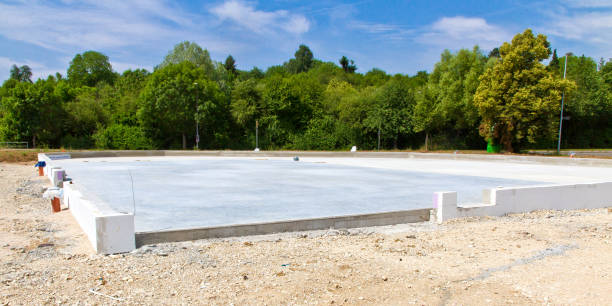
- For construction projects where there will be no basement, the slab is made by pouring a single, large layer of concrete right on top of the ground.
- More cost-effective, quicker to complete: When compared to excavating and building a full basement, this type of project typically has lower costs and is completed much faster due to less site preparation and fewer materials required.
- It can be well-suited to Boston’s climate if properly insulated. To avoid heat loss and protect the slab from frost heave, we use rigid foam insulation along the perimeter.
Full Basement Foundation
- Increases usable square footage: This is the most commonly used foundation type in Boston; a basement can add significant space to your property.
- Protects from extreme weather conditions: A full basement provides a stable, temperature-regulated area below the surface of the weather.
- Must be properly waterproofed in Boston’s rainy season: In order to protect against spring rainfall and high water table levels, we emphasize advanced drainage systems and exterior membranes to keep your basement completely dry.
Crawl Space Foundation
- Between slab and full basement foundation types: Short wall foundations create a crawl space under the house.
- Allow easy access for utility maintenance: This style of construction allows plumbing and electrical personnel easy access to the home’s mechanical systems.
- Requires proper ventilation to prevent moisture problems: To keep humid air from entering and possibly causing damage to the floor joists, we install specialized vents and vapor barriers.
Pier and Beam Foundation
- Best for areas with expansive soils: Concrete piers are placed deep into the ground, bypassing the unstable surface soils to place them into more stable sub-soil layers.
- Good ventilation and protection from flooding: Elevation of the structure is an excellent solution for properties in low-lying and coastal areas, which are subject to periodic flooding.
- An ideal solution for sloping lots found in many Boston neighborhoods: This type of construction allows us to construct a level home on uneven land without requiring large and costly earth-moving operations.
Our Concrete Foundation Installation Process
Our concrete foundation process is built on precision and local knowledge, ensuring every project stands strong against the unique challenges of the Massachusetts landscape.
- Evaluation of the Site: Soil composition, water table elevation, and local building codes are evaluated before excavation. We also evaluate the potential impact of the weight of a structure on the land before any excavation. The evaluation of the water table elevation is particularly important when working in coastal or low-lying areas in Boston, as the water table elevation can cause hydrostatic pressure issues over time.
- Custom Foundation Plan Development: Each member of our team works together to develop a custom foundation plan based on your unique needs. We do not offer generic plans. All of our plans take into consideration the structural loads imposed by the building and the specific frost depths at the location to provide for the long-term stability of the structure.
- Excavation: Excavation involves preparing the site to the required depth and grade. We carefully excavate to the exact required depth, remove any organic materials, and replace them with engineered fill if needed to create a solid and level “floor” for your new foundation.
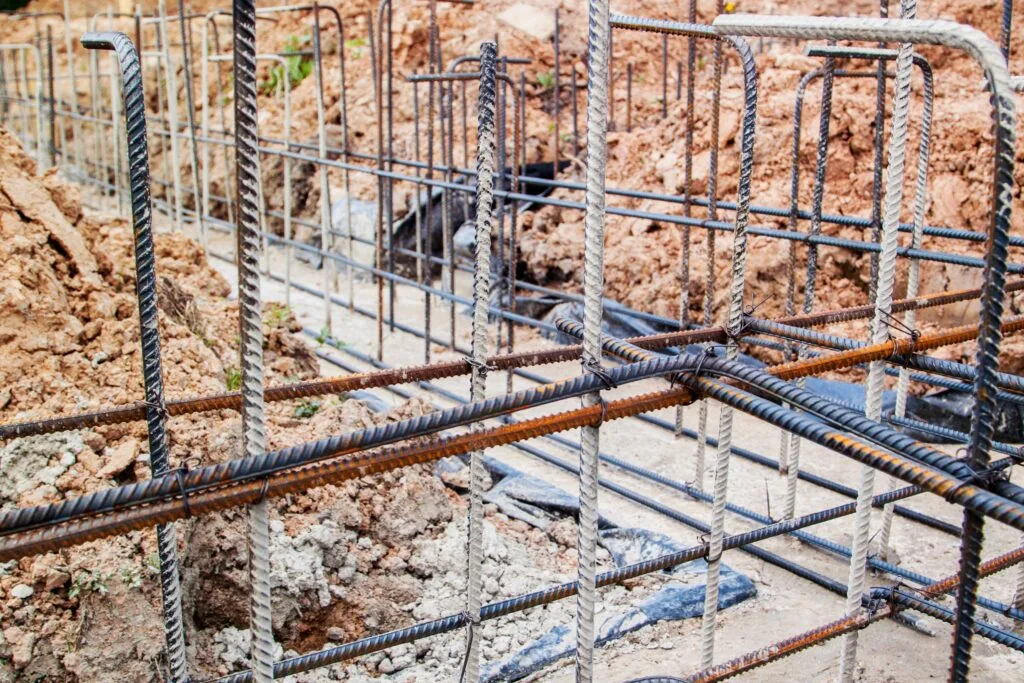
- Formwork and Reinforcement: Forms are installed, and steel reinforcement is placed within the forms to add strength to the foundation. High-pressure forms are built to contain the wet concrete, and steel rebar is strategically located to provide the foundation with the tensile strength needed to support the compressive force of the surrounding earth.
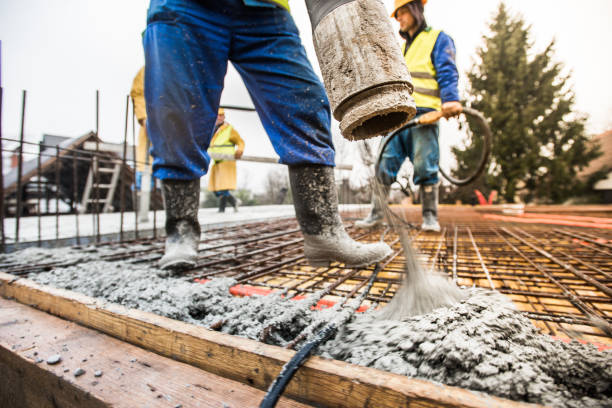
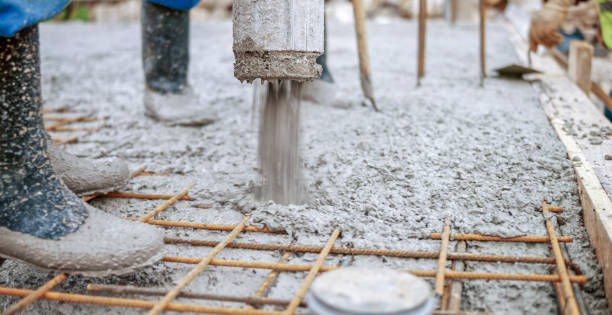
- Pouring: High-quality concrete is used to pour the foundation, which is specifically formulated to withstand the climate of Boston. The strength of the concrete (PSI) used is selected to meet the structural demands of a foundation and may include air entrainment. Air entrainment introduces small air bubbles in the concrete, which allows the concrete to expand and contract during freeze/thaw cycles without cracking.
- Curing: Curing is an extremely critical component to developing the strength of the foundation. Concrete does not simply “dry,” but rather it goes through a chemical reaction. During this phase, managing both moisture and temperature is critical to allowing the slab to reach its full design strength prior to placing any weight on the foundation.
- Waterproofing: Advanced waterproofing systems are applied to the foundation to protect it from moisture. An external membrane or crystalline coating is applied to prevent moisture in the porous concrete from being drawn into the concrete from the surrounding damp New England soil.
- Inspections: Prior to completing the project, we thoroughly inspect the completed work to ensure that it complies with all applicable local codes and regulations. We verify that each dimension and reinforcement detail has met or exceeded all applicable local codes and regulations to provide you with complete confidence in the integrity of your new foundation.
Why Choose Boston Concrete Works for Your Foundation?
- Deep understanding of Boston’s unique geology and regulatory environment: Our foundation engineers have extensive knowledge of Boston’s regional soil conditions, frost levels, and local building codes, which directly impact every job. This level of knowledge allows us to ensure that your footings will be set below the frost line (in most areas of Massachusetts, this is approximately 4’) to protect against the structural damage caused by shifting earth.
- Quality products used in all of our foundation projects: All of our concrete mix designs are specifically formulated to meet the harsh environmental conditions found in New England without failure. Additionally, all of our foundations are constructed using high-performance, air-entraining concrete that has superior resistance to the freeze/thaw cycles that can lead to scaling and internal pressures.
- Careful Engineering: As mentioned earlier, all of our foundations are carefully engineered to prevent settlement or cracking in the future. We use precise calculations to determine the required load-bearing capacity of the foundation and then position the reinforcement accordingly to meet the specific weight and stress loads of your building.
- Advanced Techniques: We are always utilizing the latest advances in foundation technology and waterproofing systems on every single one of our jobs. Whether it’s the utilization of advanced leveling tools such as laser-leveling to achieve a perfect level pour or the installation of rubberized membranes, we are at the forefront of the industry to provide you with a dry and strong subgrade.
- Years of Experience: Our staff has numerous years of “hands-on” experience in foundation repair and new construction in Boston. They have also experienced and dealt with many of the unique challenges that exist due to the diverse topography of Boston, including the rocky outcroppings of the surrounding hills and the densely populated urban lots throughout the city.
- Completion of Jobs on Time: Every one of our projects is completed within the scheduled timeframe, thus maintaining our overall construction schedules. Because the foundation of a structure is typically the critical path for any type of building project, we take great pride in coordinating and scheduling all of the necessary foundation pours and inspections precisely to allow the next phase of your building project to begin immediately.
Foundation Maintenance Tips for Boston Homeowners
- Check for hairline cracks. Hairline cracks happen when your home settles, but if you have an opening that is larger than a quarter inch or appears to grow, you should investigate this further. In Massachusetts, even a slight crack can provide an entry point for water into your wall, where it can then freeze and create additional stresses as it expands within the confines of the structure of your wall over time.
- Be sure that there is adequate drainage around your foundation so that water will not accumulate and put pressure on the concrete. Your yard should always be sloped away from your foundation walls. When your yard collects water with each storm in the area, it creates hydrostatic pressure that puts pressure on your walls to allow water in or causes them to buckle under the weight of the water pressure.
- Help keep the soil around your foundation evenly moistened. Rarely does the clay-based soil surrounding Boston shrink and pull away from your foundation due to a lack of moisture in the soil. Consistently keeping the soil around your foundation moist, just enough to keep it from shrinking significantly, helps to provide the necessary side support for your foundation walls.
- Regularly inspect your property for damage, especially after inclement weather events. Take a walk around your property after a large snowstorm or after a flood event to check for signs of “heaving” (the ground pushing upward), or new cracks on your walls inside the basement. These are often the first indication that the recent weather has caused damage to your foundation walls’ integrity.
- Clean out your gutters, and ensure that your downspouts direct water away from your foundation. Protecting your base from potential water intrusion may be the easiest yet most effective method to protect your home from damage. Be sure to discharge water from your downspout(s) a minimum of five to ten feet away from your home to avoid creating saturated soil conditions that could increase the amount of pressure exerted upon your walls by the weight of the water.
Ready to Build on a Solid Foundation?
Whether people are setting up a new house around here. Or maybe adding on to what they already got. Or even just fixing up the base of it all. Boston Concrete Works steps in to make sure everything gets off on a solid foot. The idea is to team up and put down something sturdy. That can handle all the rough stuff Boston throws at buildings over time.
Contact us today for a free consultation and quote. Discover why we’re Boston’s go-to experts for rock-solid foundations.
Phone: (617) 958-2158
Email: info@bostonconcreteworks.com
Boston Concrete Works – Laying the Groundwork for Boston’s Future, One Foundation at a Time.
FAQs About Concrete Foundations in Boston, MA
Yes, we can pour concrete foundations year-round in Boston, but winter installations require special techniques:
- Using heated enclosures to maintain proper curing temperatures
- Adding accelerants to the concrete mix
- Careful planning around weather forecasts We take extra precautions to ensure your foundation cures properly, even in cold weather.
We employ several strategies:
- Using air-entrained concrete mixes that allow for expansion
- Proper drainage systems to prevent water accumulation
- Insulation techniques to maintain consistent temperatures
- Waterproofing measures to prevent moisture penetration These methods help ensure your foundation remains stable despite temperature fluctuations.