
Menu
A Beginner’s Guide to Measuring for a Concrete Slab
Concrete Slab Boston
Making accurate material estimates on your concrete slab project in Boston is very important because it will allow you to avoid costly overages or delays, which will impede your ability to complete your project. A reliable concrete slab calculator can be helpful to homeowners and contractors as they need to determine their concrete volume, total cost, and materials needed for concrete slabs throughout Greater Boston. We have been using a professional concrete slab calculator so that regardless of whether your project is in Cambridge or Newton, you are receiving a precise amount of materials for a successful outcome.
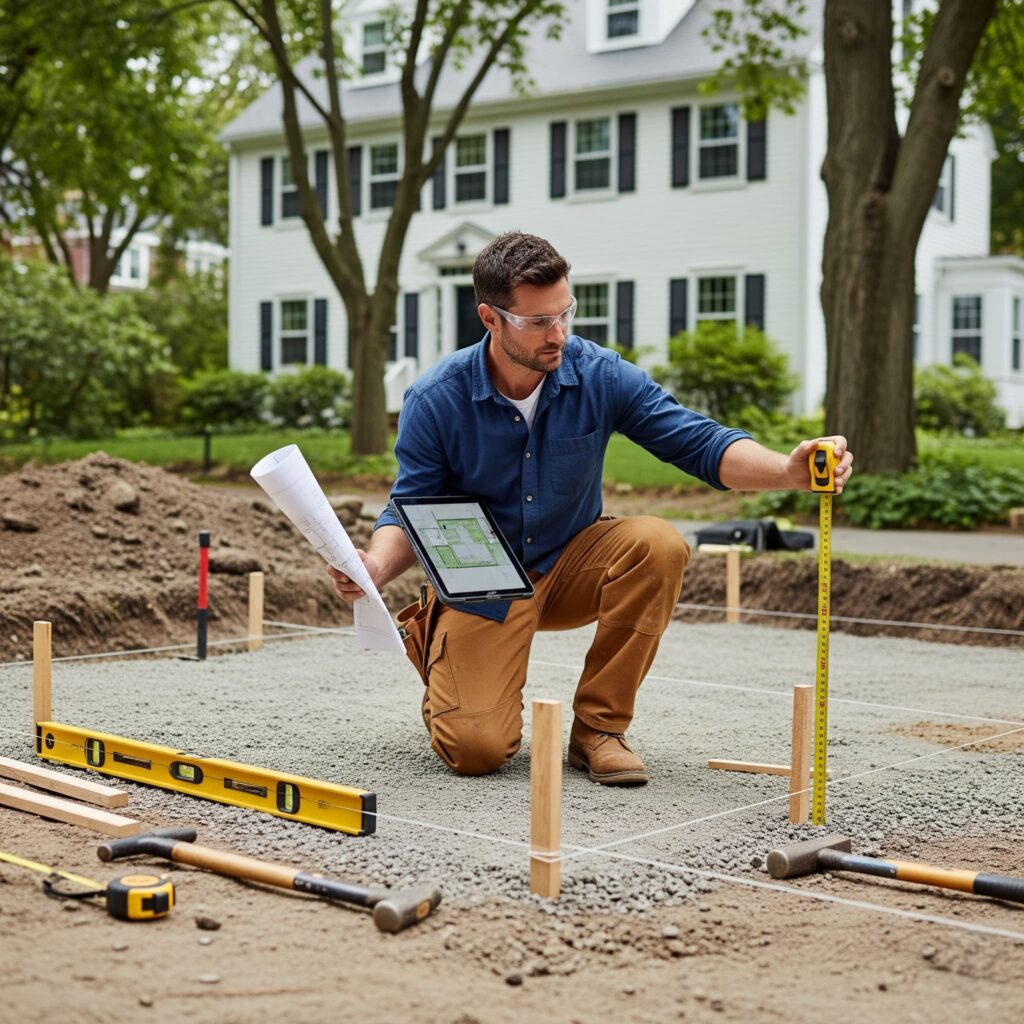
How to Use a Concrete Slab Calculator
Using a concrete slab calculator allows you, as a Boston property owner, to plan your project. For example, if you are laying a garage slab in Somerville or laying the foundation for a patio in Back Bay, you want to make sure you have enough materials. Not having enough materials will add unforeseen costs to your project.
Concrete Slab Calculator Equation
The basic formula for a concrete slab calculator is:
Volume = Length × Width × Thickness
In Boston, you will want to measure everything in feet and enter your thickness in decimal form:
- 4-inch thick slab = 0.33 ft thick
- 5-inch thick slab = 0.42 ft thick
- 6-inch thick slab = 0.5 ft thick
Calculating Cubic Yards
Since most concrete is sold in cubic yards, your concrete slab calculator will have to convert cubic feet to cubic yards:
Cubic Yards = (Length × Width × Thickness) ÷ 27
Concrete Slab Calculator Inputs
You will need to determine the proper thickness of your concrete for the type of application you are doing. Boston’s climate requires different thicknesses of concrete for the following:
- Walks and sidewalks: 4 inches (the most common in the North End, where space is small)
- Light-use patios: 4–5 inches (most common in Beacon Hill courtyard spaces)
- Driveway and garage slabs: 5–6 inches (most common in Charlestown parking spaces)
- Industrial applications using heavy equipment: 6+ inches (most common in South Boston industrial uses)
Irregularly Shaped Areas
To accurately estimate the amount of concrete you need for an area that has an irregular shape, you will need to break it down into smaller rectangles to easily calculate the area. To account for curves, you will need to approximate the curves and consider them when calculating the thickness needed due to the slope of the slab. Document all obstacles to ensure you are not estimating the entire slab but only the usable portion.
Concrete Slab Calculator Examples for Specific Projects
Garage Slab Calculations
A single-car garage that measures 12′ x 24′:
- Volume: 12 × 24 × 0.42 = 120.96 cubic feet
- Cubic yards: 120.96 ÷ 27 = 4.48 cubic yards
- Add 10% for waste: 4.93 cubic yards
A two-car garage measuring 24′ x 24′:
- Volume: 24 × 24 × 0.42 = 241.92 cubic feet
- Cubic yards: 241.92 ÷ 27 = 8.96 cubic yards
- Add 10% for waste: 9.86 cubic yards
Patio Slab Estimates
Small patio measuring 10′ x 12′:
- Estimate for a 4-inch slab: 1.48 cubic yards
- Estimate for a 5-inch slab: 1.85 cubic yards
Large patio measuring 20′ x 30′:
- Estimate for a 4-inch slab: 7.41 cubic yards
- Estimate for a 5-inch slab: 9.26 cubic yards
Basement Slab Estimates
Standard basement measuring 24′ x 32′:
- Estimate for a 4-inch slab: 11.85 cubic yards
Estimates for partial basement areas:
- Calculate only the areas of the basement that will require poured concrete.
- Account for any existing footings, which will reduce the total volume of concrete that will be required.
Material Estimates Beyond Concrete Volume
Reinforcement Estimates
- Spacing for #4 rebar: 18–24 inches on center
- Alternative to rebar: 6×6 W1.4xW1.4 welded wire mesh
- Fibers (synthetic): 1–1.5 lbs/cu yd
- Fibers (steel): 30–40 lbs/cu yd
Base Material Estimates
- Gravel base: 4–6 inches compaction
- Sand leveling course: 1–2 inches
- Vapor barrier: Include in basement projects
Boston-Specific Concrete Slab Calculator Considerations
Minimum Orders for Local Suppliers
- All suppliers require a minimum order of 1 cubic yard.
- Transit-mix truck capacity: 8–10 cubic yards.
- Smaller orders result in a higher cost per yard.
- Pumping may be required for tight access.
Seasonal Pricing Factors
- Peak Season (May–Sept): Higher prices.
- Shoulder Seasons: Moderate prices.
- Winter: Additives required due to limited availability.
Municipal Requirements
- Permits vary in price depending on the municipality.
- Inspectors may require delays in completion.
- Setbacks may limit the size of your slab.
Tools and Equipment
- Mobile apps for site measurement
- Online calculators with cost estimations
- Professional software for complex shapes
Boston Concrete Works Estimation Services
- On-site measurement of site-specific conditions
- Optimization of materials
- Coordination of supplier delivery
- Development of project timelines
Common Concrete Slab Calculator Mistakes
Measurement Errors
- Failure to convert inches to feet
- Failure to include 5–10% waste
- Failure to account for sloping requirements
- Failure to account for varying thickness requirements
Oversights in Planning
- Delivery truck access
- Contingency planning for weather
- Availability of tools and equipment
- Scaling labor according to the size of your project
Cost Estimation Based Upon Concrete Slab Calculator Results
Material Costs
- Ready-mix concrete: $125–$150/cu yd
- High-strength mix: $150–$175/cu yd
- Decorative mix: $175–$225/cu yd
- Rebar: $0.75–$1.25/ft
- Wire mesh: $0.35–$0.50/sq ft
Labor Costs
- Site prep: $2–$4/sq ft
- Placement: $3–$6/sq ft
- Finishing: $1–$3/sq ft
- Install Total: $8–$15/sq ft
When to Use a Professional Beyond Simple Calculations
Projects Requiring Complex Requirements
- Sites with slopes and drainage
- Heavy-load applications
- Underground utilities
- Restrictions from historic property regulations
Boston Concrete Works Professional Services
- Soil analysis
- Structural design
- Obtaining permits
- Quality assurance
Increasing the Accuracy of Your Concrete Slab Calculator
Pre-Project Planning
- Measurements should be taken multiple times.
- Use surveys for large projects.
- Test the soil for base preparation.
- Plan around Boston weather.
Working with Local Experts
- Knowledge of materials used in Boston
- Relationships with local suppliers
- Expert installation
- Project management
Are You Ready to Move Beyond Your Concrete Slab Calculator?
While a concrete slab calculator helps make initial plans for your project, successful concrete jobs in Boston require both local knowledge and professionals to do the work properly. At Boston Concrete Works, we provide accurate material estimates along with experienced installation to help transform your project from a set of numbers into a finished product.
If you are planning a garage slab in Somerville or a patio base in Newton, you will find that our company assists with simple calculator outputs. We assist with all aspects of your project, from the initial stages through completion.
Call us today to receive professional concrete slab calculator services and expert installation to create long-lasting, high-quality concrete products throughout the Greater Boston area.
LATEST POSTS
Cost & ROI of Decorative Concrete Upgrades for Boston Homes
September 24, 2025
No Comments
Stamped Concrete Mistakes to Avoid in Wet/New England Climates
September 22, 2025
No Comments